


Businesses invest heavily in blogs, service pages, and location content — only to watch their rankings behave unpredictably. The pages bounce. Traffic splits. Conversions drop. None of it makes obvious sense, until keyword cannibalization is identified as the root cause.
Key Takeaways
- Keyword cannibalization happens when multiple pages target the same keyword or intent — splitting authority and reducing rankings for all of them
- GSC impression splits, the site: operator, and rank "dancing" are the three fastest ways to detect the problem
- Consolidation via 301 redirects is the most effective fix — merging competing pages into one authoritative resource
- Cannibalization also damages paid search Quality Scores — fixing organic issues improves CPC performance too
- A professional SEO audit service goes beyond surface checks — it examines internal linking, schema, index health, and AI visibility
- Prevention requires a keyword-to-URL map, topic cluster structure, and monthly GSC audits as content scales
- In 2026, a website with 50 high-authority, clearly distinct pages will always outperform one with 500 overlapping, confused pages
What Exactly Is Keyword Cannibalization in SEO?
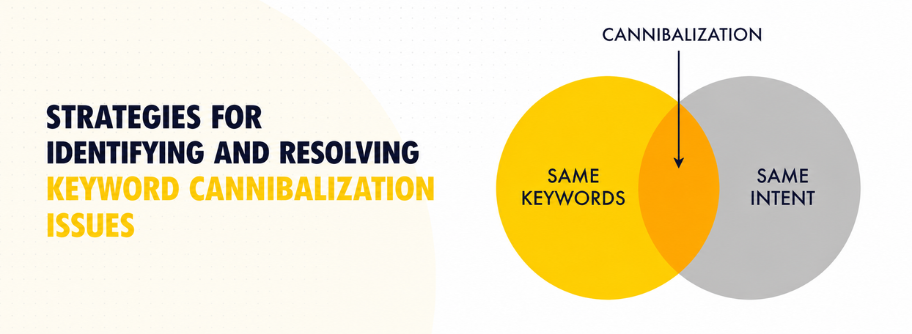
Think of a website as a fleet of ships, each carrying cargo to the same destination. Sending five ships with identical cargo at the same time doesn't increase efficiency — it splits resources and reduces overall performance. Keyword cannibalization works the same way.Keyword cannibalization happens when multiple pages on the same website target the same keyword or search intent. Instead of one strong page ranking at the top, several weaker pages compete against each other — leaving Google confused about which one to prioritize.
The result: instead of one page sitting at position #1, three pages rank at positions #14, #22, and #35. No one wins.
Common situations where cannibalization occurs:
- Blog vs. Service Page Clash: An informational blog post outranks the actual service page it was meant to support — bringing traffic but zero conversions
- Location Page Overlap: Multiple city or area pages with near-identical content and intent end up competing with each other
- Product Page Duplication: Similar product variants or category pages targeting the same transactional keywords
- Old vs. New Content: An updated article competing with its older version that was never redirected or consolidated
How to Detect Keyword Cannibalization Before It Damages Rankings Further
Detecting cannibalization in 2026 is about identifying "ranking volatility" — the pattern where positions jump and fall unpredictably across the same keyword cluster. Here are the three most reliable detection methods:Google Search Console (GSC) Deep Dive
Open GSC and filter by a specific high-volume keyword. Navigate to the "Pages" tab. If two or more URLs appear for that single keyword with similar impression counts but low click-through rates (CTR), there is a cannibalization problem. The impressions are being split — and so is the authority.
The site: Search Operator
The fastest manual check. Go to Google and type:
site:yourwebsite.com "target keyword"
If the results show multiple pages with nearly identical titles and meta descriptions, Google is struggling to decide which one to rank. Often, its response is to rank none of them well.Rank Tracking "Dancing"
When a keyword's position shifts from #4 to #18 and back again every few days, that's Google trying to determine which page better matches the search intent. That volatility is a reliable signal of cannibalization.
The Recovery Roadmap: Fixing Keyword Cannibalization to Reclaim Rankings
Once the problem is confirmed, there are two core strategic approaches depending on the situation:Move A — The Powerhouse Consolidation (Recommended for 2026)
Take the strongest elements from competing pages and merge them into one authoritative, comprehensive page. Pull unique data, statistics, and supporting content from the weaker page and fold it into the stronger one. Then set up a 301 redirect from the old URL to the consolidated page. This tells search engines: everything valuable from the old page now lives here — and transfers the authority accordingly.Move B — Intent De-Optimization
When both pages genuinely need to exist, restructure them to target different stages of the buyer journey. One page targets the transactional intent (service or product), while the other targets the informational intent (how-to or guide). Different headings, different angles, different purposes — so they complement rather than compete.What Is Keyword Cannibalization Doing to Ad Performance?
Organic cannibalization doesn't stay in the organic lane. When Google's algorithm is uncertain which page represents the business best, Quality Scores in paid campaigns suffer too. A lower Quality Score means higher Cost-Per-Click (CPC) and lower ad placement — paying more for worse results.Fixing keyword cannibalization in SEO often has a direct positive knock-on effect on paid search efficiency. That's a benefit many businesses overlook entirely.
Why a Professional SEO Audit Service Is the Fastest Path to Recovery
Manual checks catch surface-level issues. But enterprise-level cannibalization — across hundreds of pages, multiple content types, and complex internal linking structures — requires a systematic, professional approach.A professional SEO audit service doesn't just hunt for duplicate keywords. It examines the entire architecture of authority across the site. Here's what a thorough 2026 SEO audit uncovers:
- Internal Linking Gaps: Poor internal linking often signals the wrong page as the priority — a well-structured audit corrects this
- Schema Markup Errors: Structured data must clearly define what each page covers so AI engines understand the distinction
- Thin Content Identification: Pages without unique value are cannibalization risks — audits surface these before they cause damage
- Information Gain Analysis: Google in 2026 rewards genuinely new information — audits identify where unique insights can be added to differentiate pages
- Index Bloat Review: Too many low-value pages in the index dilutes overall site authority and worsens cannibalization effects
- AI Overview Monitoring: Checking whether AI-generated answers are pulling from multiple competing pages — and choosing a single winner to optimize
How to Prevent Keyword Cannibalization from Returning
The smartest fix is the one that makes the problem structurally impossible to repeat. As content production scales, these principles keep cannibalization from creeping back in:- Maintain a Keyword-to-URL Map: Before any new page or post is created, check whether a page already exists for that intent. One intent, one URL — always.
- Think in Entities, Not Keywords: Instead of targeting a single keyword phrase, build authority around a full topic. Google understands entities and their relationships — content strategy should match that logic.
- Use Topic Clusters: Create one strong pillar page per topic, then build supporting articles that link back to it. The structure signals hierarchy clearly to search engines.
- Audit on a Regular Cadence: Fast-growing websites need a GSC audit at least once a month. New content means new cannibalization risks — catch them early.
- Eliminate Thin Pages: If a page doesn't offer something genuinely distinct, merge it or remove it. Thin content is a cannibal risk waiting to activate.
Using Your SEO Audit Service to Build Long-Term Authority
The best way to fix cannibalization is to never let it happen again, follow these rules:- Map Your Keywords to URLs: Before writing, check if a page already exists for that intent.
- Think in "Entities": Instead of thinking "I need to rank for X," think "I want to be the authority on the Topic of X."
- Use Topic Clusters: Create one pillar page and link all smaller, supporting articles back to it.
Final Checklist for SEO Success in 2026
- Audit Regularly: Search landscapes evolve quickly. Conduct a Google Search Console (GSC) audit every 30 days to track performance and identify issues early.
- Check Your Language Targeting: If your site serves multiple regions or languages, ensure pages aren’t competing for the same keywords. Use proper hreflang and clear targeting.
- Eliminate Thin Content: Pages that don’t provide unique value can cause keyword cannibalization. Merge, update, or remove them to strengthen overall authority.
- Monitor AI Search Results: Review how AI-driven search features (like generative overviews) display your content. If multiple pages compete for the same query, consolidate into one strong resource.
- Focus on Quality Over Quantity: A website with fewer high-authority, well-structured pages will outperform one with hundreds of overlapping, low-value pages.
Frequently Asked Questions
What is keyword cannibalization?
Keyword cannibalization happens when multiple pages on the same website target the same keyword or search intent. Instead of helping rankings, those pages compete with each other, which can confuse Google and reduce your visibility.
Why is Keyword Cannibalization in SEO a problem?
Keyword Cannibalization in SEO can split authority between pages, lower click-through rates, and cause rankings to fluctuate. Instead of one strong page performing well, several weaker pages may struggle to rank.
Can a SEO audit service help with keyword cannibalization?
Yes, a professional seo audit service can uncover overlapping keywords, duplicate intent, weak site structure, and indexing issues. It also provides a clear roadmap to recover rankings and prevent future cannibalization problems.
Is keyword cannibalization common on growing websites?
Yes, it often happens when businesses publish blogs, location pages, or service pages regularly without a keyword map. As websites grow, cannibalization becomes more common unless content is planned carefully.
Can keyword cannibalization hurt conversions too?
Absolutely. If the wrong page ranks, users may land on an informational blog instead of a service page. That means traffic may increase while leads and sales stay low.